
This is the fastest path to more revenue.
Every few months I talk to a founder who tells me the same thing, “My business is working… but I’m exhausted.” The money is coming in but money doesn’t reflect the effort. After ten years working inside online businesses, I can tell you something that might save you a lot of time. Most founders don’t have a marketing problem.
They have a revenue model problem.
The offers in the business were built at different times for different reasons, and nobody ever stopped to examine how those pieces are supposed to work together.
That’s where a revenue and offer alignment audit becomes powerful.
It helps you see where the business is currently making money, where the opportunities are hiding, and what needs to change to reach your next revenue level.
Let me show you how this works using a real example.
An OBM Stuck at $60K
Last year I worked with an Online Business Manager making around $60,000 a year.
On paper, things looked fine. She had clients. She had recurring retainers. She had work coming in.
But she was exhausted.
She was managing multiple retainer clients at once and still feeling like she couldn’t get ahead financially.
The obvious advice people were giving her was simple.
“Raise your prices.” But every time she tried, she got pushback.
She came to looking for help with her messaging. But before we could do that, I had to figure out what was really happening in her business.
The Revenue SWOT: A Simple Way to Audit Your Business
One way I like to run this type of audit is by using a framework similar to a SWOT analysis, but focused specifically on revenue.
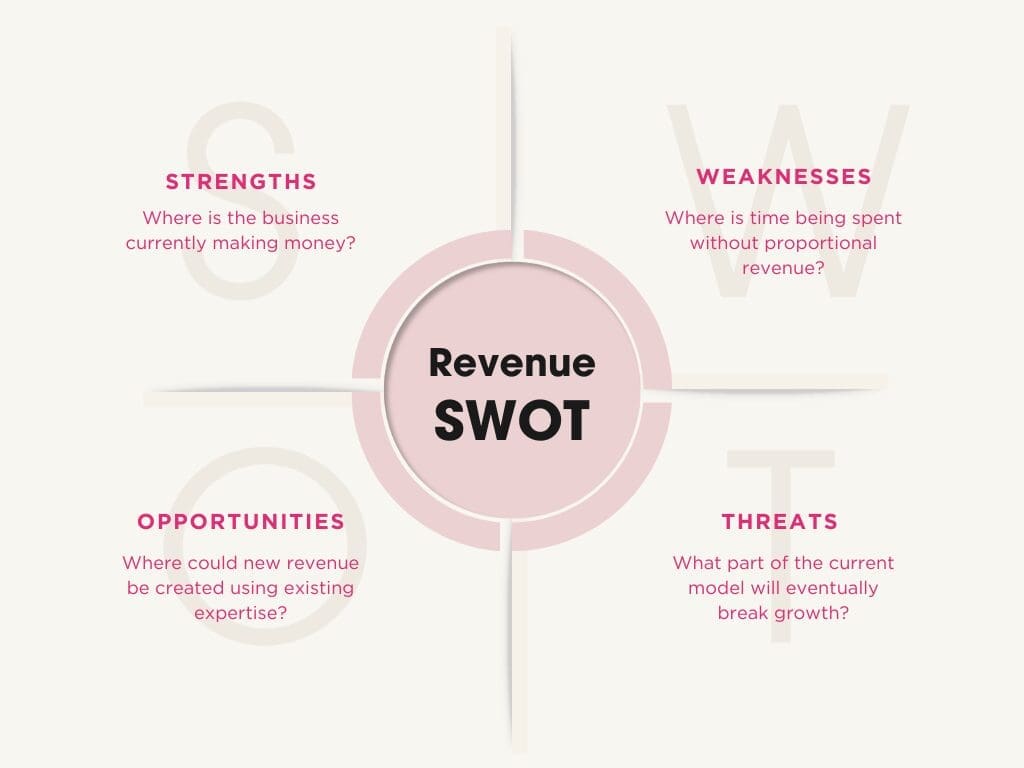
Instead of looking at general business strengths and weaknesses, we examine four revenue categories.
Revenue Strengths
Where is the business currently making money?
Revenue Weaknesses
Where is time being spent without proportional revenue?
Revenue Opportunities
Where could new revenue be created using existing expertise?
Revenue Threats
What part of the current model will eventually break growth?
When we ran this exercise for the OBM, here’s what we found.
Step One: Identify Revenue Strengths
The OBM’s strength was obvious.
She was very good at helping founders organize their operations and client onboarding.
Her clients trusted her.
Her work was solid.
And she had built a reputation for reliability.
The problem was that this expertise was only being monetized through retainers.
Which meant her revenue was directly tied to the number of hours she could personally support clients.
Step Two: Identify Revenue Weaknesses
The weakness in her revenue model was time.
Every new retainer client increased the workload dramatically.
Instead of creating leverage, the business model was creating pressure.
Even if she added two more clients, she would still be capped by her capacity.
When this happens, we have to change the question.
What if her expertise could be sold before the retainer relationship even started?
Step Three: Identify Revenue Opportunities
This is where the opportunity showed up.
Many founders were coming to her overwhelmed with operations and onboarding systems.
But they didn’t actually need an OBM yet.
What they needed first was clarity.
So instead of selling a retainer immediately, we introduced a paid assessment.
A $1,400 operational audit where she would review the client’s current backend systems and build a strategic onboarding plan for their business.
That assessment did three things at once.
It paid her for the diagnostic work she was already doing informally.
It positioned her as a strategist instead of just an implementer.
And it naturally qualified which clients should move into her retainer offer.
Step Four: Identify Revenue Threats
The biggest threat in her original model was the type of clients she was attracting.
Her messaging focused on helping founders who were overwhelmed and needed help “getting organized.”
Which meant she was attracting founders who were still figuring things out.
Once we introduced the assessment, we upgraded her messaging to speak directly to founders who were scaling and needed operational structure to support growth.
This shifted the type of client entering her ecosystem.
Instead of working with founders who were drowning in chaos, she began working with founders who were already generating revenue and needed operational support to scale.
Scaling Without Drowning In Client Work
Once the audit was complete, the revenue path inside her business became clear.
Instead of jumping directly into retainers, her model now looked like this:
Paid Assessment — $1,400
Strategic review of onboarding and operations.
Quarterly Retainer
Operational implementation and support.
The assessment served as both an entry point and a filter.
Clients who needed strategy received clarity.
Clients who needed implementation became ideal retainer clients.
The Result
Within months, the business felt different.
She was no longer taking every client who asked for help.
The paid assessment allowed her to:
qualify better clients
charge for her strategic thinking
and enter retainer relationships with founders who were already prepared to invest in implementation
Instead of chasing more clients, she was working with better clients.
That shift alone created a clear path from $60K toward $100K.
How to Run This Audit for Your Own Business
If you want to run this type of revenue audit, start with these questions.
- Where is your revenue currently coming from?
- Which parts of the business consume the most time?
- Where could your expertise be monetized earlier in the buyer journey?
- And what type of clients does your current messaging attract?
Those four questions will often reveal the fastest path to more revenue.
Scaling a business doesn’t always require more marketing.
Sometimes it simply requires redesigning how your expertise is monetized.
When the revenue model changes, the entire business changes with it.
And suddenly the path to your next revenue level becomes much clearer.
If This Article Made You Rethink Your Business…
Then you’re exactly the type of founder this audit was designed for.
Reading about revenue alignment is one thing.
Seeing exactly how your offers, audience, and sales should work together inside your own business is something completely different.
Inside the Revenue & Offer Alignment Audit, we take the exact process you just read and apply it directly to your business.
Together we will:
• evaluate how your current offers actually produce revenue
• identify where your model is creating pressure or client misalignment
• map the client value ladder inside your business
• and determine the next structural move that increases revenue without increasing workload
This is not a discovery call.
It’s a working session with a clear outcome.
You will leave with a real revenue map for your business.
And if deeper work makes sense after that, we’ll talk about it.
If not, you’ll still walk away knowing exactly what needs to change.
Learn more about the Revenue & Offer Alignment Audit
Take the Revenue & Offer Alignment Quiz to find the revenue leaks in your business.
Written by: Kim McCarter, Digital Education, Revenue & Implementation Strategist


