
Digital education does not fail because of technology, it fails because it forgets the human behind the screen. For years, organizations and coaches have tried to fix digital learning with better platforms, flashier dashboards, and tighter automation. We have automated content. We have automated connection. But we have not learned how to regulate capacity. As a Digital Education Strategist, I see this as a fundamental misunderstanding of “buying” psychology. In sales, we know a frantic, dysregulated customer never commits. Yet in learning, we expect dysregulated employees & students to commit to complex new skills. When a learner’s nervous system is overloaded, it does not matter how good the curriculum is. The brain cannot learn when the body does not feel safe. Ignoring the benefits of emotional wellness in digital learning is costing businesses more money than you may realize.
The Sales-First Gap: Why Wellness is a Business Strategy
To understand where we are, we have to look at where we came from. For more than a century, education and corporate training followed the industrial model. Success was measured by output, memorization, and efficiency.
When learning went digital, we simply digitized the factory. We traded chalkboards for screens and human connection for automation. The systems got faster, but people felt unseen.
Then the pandemic hit. Companies moved training online overnight, and what started as innovation quickly turned into exhaustion. The result? Quiet Quitting.
Quiet quitting is not about laziness. It is a nervous system response. It is the body saying, “I cannot keep up with the way I am being asked to learn and live”.
This is the core tenet of my ID•EQ Method™: Emotional wellness is not a “soft skill” or a perk. It is the prerequisite for retention. If you want your learners to “buy in” to the training, you must first create the physiological capacity for them to do so.
Defining Emotional Wellness in Digital Education
Digital education is more than putting information online. It is the intentional design of how people learn, remember, and apply knowledge.
In the context of the ID•EQ Method™, emotional wellness is the learner’s ability to feel psychologically safe, self-regulated, and supported while engaging in the process. It is the balance between stimulation and safety—the point where curiosity thrives because fear is absent.
When digital learning and emotional wellness meet, learning becomes transformation.
The Cost of Ignoring Capacity
For the CLO (Chief Learning Officer) or Course Creator looking at the bottom line, the cost of ignoring this is measurable:
- Global Impact: The World Health Organization reports that poor mental health costs the global economy nearly one trillion dollars every year in lost productivity.
- US Impact: A 2019 Gallup poll showed that U.S. businesses lose between $450-550 billion annually to ineffective training and disengaged employees.
Employees are not resisting your training because they lack motivation. They are resisting because they are overwhelmed. In today’s economy, attention is currency and emotional bandwidth is productivity.
The Invisible Load: Why Your Learners Are Shutting Down
We cannot talk about learning retention without talking about the environment our learners are living in. Your employees and students are not learning in a vacuum. They are attempting to process complex new information while navigating a “Polycrisis”:
- The Cognitive Load: The 24/7 news cycle and “doom scrolling” loop that keeps the nervous system in a constant state of low-grade fight-or-flight.
- The Economic Load: The rising cost of living creates a baseline of financial anxiety that consumes mental bandwidth before the workday even begins.
- The Post-Pandemic Hangover: A collective exhaustion where the line between “work” and “home” has been permanently blurred.
And here lies the great irony of the digital education industry:
When we design Sales Pages, we respect this reality. We use short paragraphs, bold hooks, and “dopamine-driven” design because we know we have to fight for attention. We promise ease. We promise transformation without burnout.
But the moment they buy the course or start the corporate training? We pull a bait-and-switch.
We dump 3-hour unedited Zoom recordings, dense PDFs, and clunky LMS interfaces onto an already overloaded nervous system.
“You use psychology to get their money, then abandon psychology when it’s time to help them learn.”
This isn’t just “bad design.” It’s a breach of trust. And it is exactly why your completion rates are plummeting.
Social Emotional Learning (SEL) for Adults
Social Emotional Learning (SEL) isn’t just for K-12; it is a brain-based, evidence-driven skill set that modern professionals are starving for. The Collaborative for Academic, Social, and Emotional Learning (CASEL) defines the core competencies as Self-Awareness, Self-Management, Social Awareness, Relationship Skills, and Responsible Decision-Making.
Most professionals enter the workforce with strong degrees but underdeveloped emotional literacy. This gap creates leaders who can’t give feedback and high-performers who burn out.
Soft skills are the hard skills now. You can teach someone the latest AI tool, but if they cannot regulate their frustration, that technical skill has limited ROI.
The R.A.E. Formula: A Sales-First Retention Model
How do we fix this? We stop designing for content consumption and start designing for human capacity. This is where my R.A.E. Formula (Remember, Apply, Engage) comes to life:
- Remember: Begins in a regulated mind. (A stressed brain cannot encode memory).
- Apply: Happens when confidence outweighs fear. (Objection handling).
- Engage: Thrives when connection replaces stress. (Building loyalty).
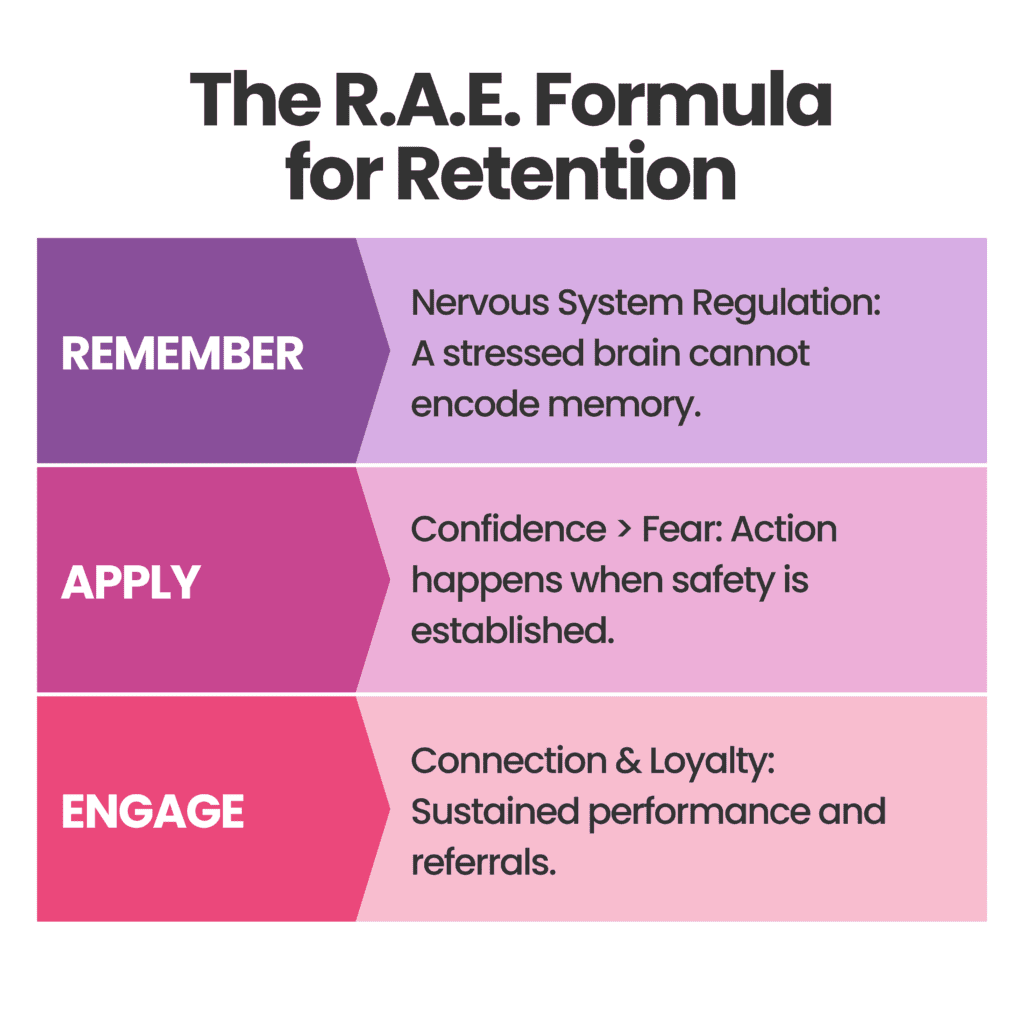
When learners feel safe, they remember more and act faster, not because the system forces them to, but because it feels good to succeed.
The Future of Learning
The next era of learning will not be defined by new technology. It will be defined by how well we bring humanity into the process.Whether you are a corporation measuring psychological safety or an entrepreneur protecting your completion rates, the truth remains the same: The missing link in digital education was never technology. It has always been emotional wellness.
Written by: Kim McCarter, Digital Education, Revenue & Implementation Strategist


