
You’ve seen it before: the course with single-digit completion rates. The corporate training program employees click through but never apply. The premium program with glowing sales pages but disappointing results.
Your training isn’t failing because of bad content. It’s failing because it was never designed for how humans actually learn.
After a decade of designing sales systems that convert customers and learning systems that transform lives, I’ve identified the pattern. The same psychology that moves people from awareness to action in sales is the missing link in digital education.
That’s why I created the ID•EQ Method™—a framework that treats learning design like a sales funnel, integrating instructional design with emotional wellness to create systems people actually finish, use, and get results from.
The Problem: Training Built for Platforms, Not People
Most digital learning is designed backward. We start with the platform (the LMS, the course builder) and work our way to the content. We ask: “What can this platform do?” instead of “What does the human brain need?”.
The result? Learning experiences optimized for content delivery, not transformation. The data proves the cost of this mistake:
- Completion is Low: Average online course completion rates hover around 5-10% (Optional Reading: Why Most Digital Training Fails)
- Retention is Poor: Employees forget 70% of new information within 24 hours without reinforcement (The Learning Guild, 2018).
- Burnout is High: Stress and burnout cost organizations $1 trillion annually in lost productivity (WHO, 2022).
These aren’t just statistics. They represent real people who logged in with hope, got overwhelmed, and quietly gave up.
What is the ID•EQ Method™?
A proprietary framework that integrates Instructional Design (ID) with Emotional Intelligence (EQ). It replaces "content dumping" with a Sales-First approach, treating every learning module as a "micro-sale" that the learner’s nervous system must buy into before they can retain information.
The ID•EQ Difference: Sales Psychology Meets Learning Science
The ID•EQ Method™ is built on a simple premise: learning design and sales design use the same psychology.
Both require you to earn attention, build conviction, remove friction, and sustain engagement. The difference? Most sales funnels are ruthlessly optimized for these outcomes. Most learning systems aren’t.
Here is how we translate Sales Psychology into Learning Retention:
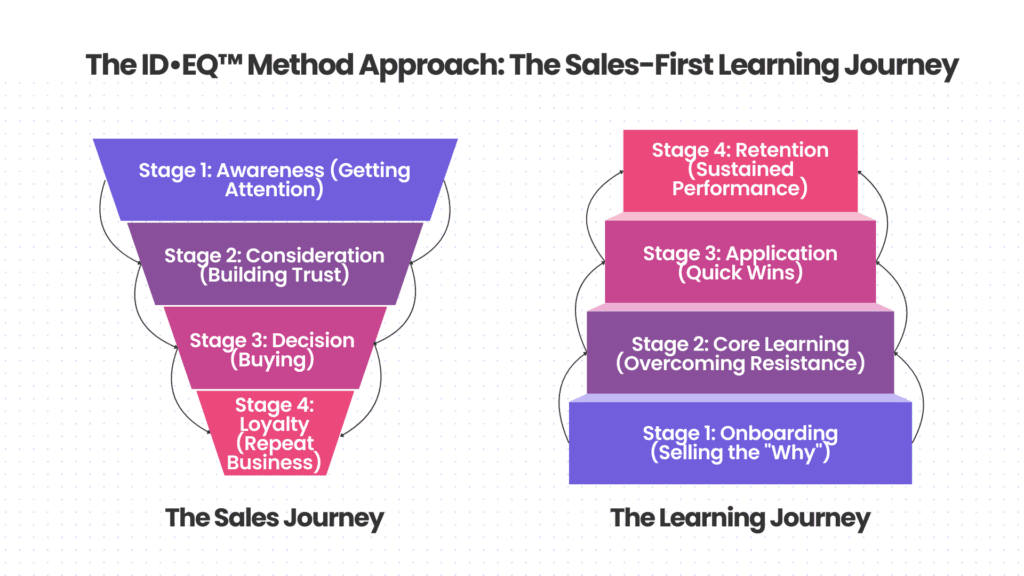
Most training ignores the funnel. The ID•EQ Method™ treats every module like a micro-sale.
- Awareness becomes Onboarding: Instead of just “starting,” I design onboarding that helps learners understand why this training matters to them.
- Consideration becomes Core Learning: Instead of just “teaching,” I design content that addresses learner resistance and builds confidence.
- Decision becomes Application: Instead of waiting for the end, I design application moments inside the learning so learners experience quick wins.
Part 1: (ID) Instructional Design Grounded in Cognitive Science
Instructional design isn’t just “organizing content.” It’s the application of how memory, attention, and cognition actually work. The ID•EQ Method™ moves beyond “content dumping” by applying research-backed principles:
- Spaced Repetition: Distributing learning over time dramatically improves long-term retention, solving the “Forgetting Curve” problem.
- Retrieval Practice: Actively recalling information (through quizzes or prompts) beats passive re-reading.
- Managing Cognitive Load: The brain can only process so much new information at once. We prevent “shutdown” by managing the cognitive load.
Part 2: (EQ) Emotional Wellness as the Foundation of Engagement
Traditional instructional design misses something very important: the nervous system controls whether the brain can learn.
When someone is stressed, anxious, or overwhelmed, their body goes into survival mode. The prefrontal cortex (responsible for learning) gets overridden by the amygdala (responsible for threat detection).
Translation: A stressed learner cannot learn effectively, no matter how good your content is.
(Read more about the biology of learning in my article: Emotional Wellness in Digital Learning).
The ID•EQ Method™ integrates emotional wellness through:
- Capacity Protection: Breaking content into digestible chunks to respect attention spans.
- Psychological Safety: Creating environments where questions feel safe, not risky.
- Regulation Prompts: Including self-check-ins that help learners stay present.
The R.A.E. Outcomes: What Success Actually Looks Like
When you apply the ID•EQ Method™, you move beyond “completion rates” and achieve what I call R.A.E. Outcomes:
1. Remember (Retention protects Investment)
Without retention, training is a recurring cost. Every time someone forgets and needs retraining, you’re spending money twice.
- The Result: Fewer refresher courses and stronger institutional knowledge.
2. Apply (Transfer proves ROI)
Knowledge that stays theoretical has zero business value. Application is what turns learning into performance.
- The Result: Measurable productivity improvements and faster onboarding.
3. Engage (Participation sustains the System)
Low engagement means wasted budgets. High engagement creates momentum and loyalty.
- The Result: Higher completion rates and better learner satisfaction.
Who This Is For
The ID•EQ Method™ works for anyone building learning systems that need to drive real results:
- For Corporate L&D Teams: Redesign training that employees actually complete and prove measurable business impact to leadership.
- For Coaches & Course Creators: Stop losing clients to low completion rates. Design programs people finish so they buy your next offer.
- For Consultants: Turn your methodology into a scalable learning system that works without you being the bottleneck.
The Business Case for ID•EQ
Designing for humans isn’t soft—it’s strategic. When you honor how people actually learn (ID) and create environments where they can actually engage (EQ), the ROI is undeniable.
You shift learning from an expense to an asset. From a compliance requirement to a competitive advantage. Ready to design learning that actually works? Explore how I help organizations and entrepreneurs build digital education systems using the ID•EQ Method™.
Written by: Kim McCarter, Digital Education, Revenue & Implementation Strategist


